Answer validation
The first self-critical legal AI
The Jurata® Legal Agent checks semantically whether the cited source supports each statement, flags uncertainty and automatically corrects unsupported statements.
Why this is important
Hallucinations have real consequences.
Even renowned law firms and consultancies are affected. A source’s existence is not enough: its content must support the statement. That is what semantic validation checks.
Fortune · 18 May 2025

Latham & Watkins / Anthropic: Claude invents a source’s title and authors.
Read original article ↗
Associated Press · 22 May 2025
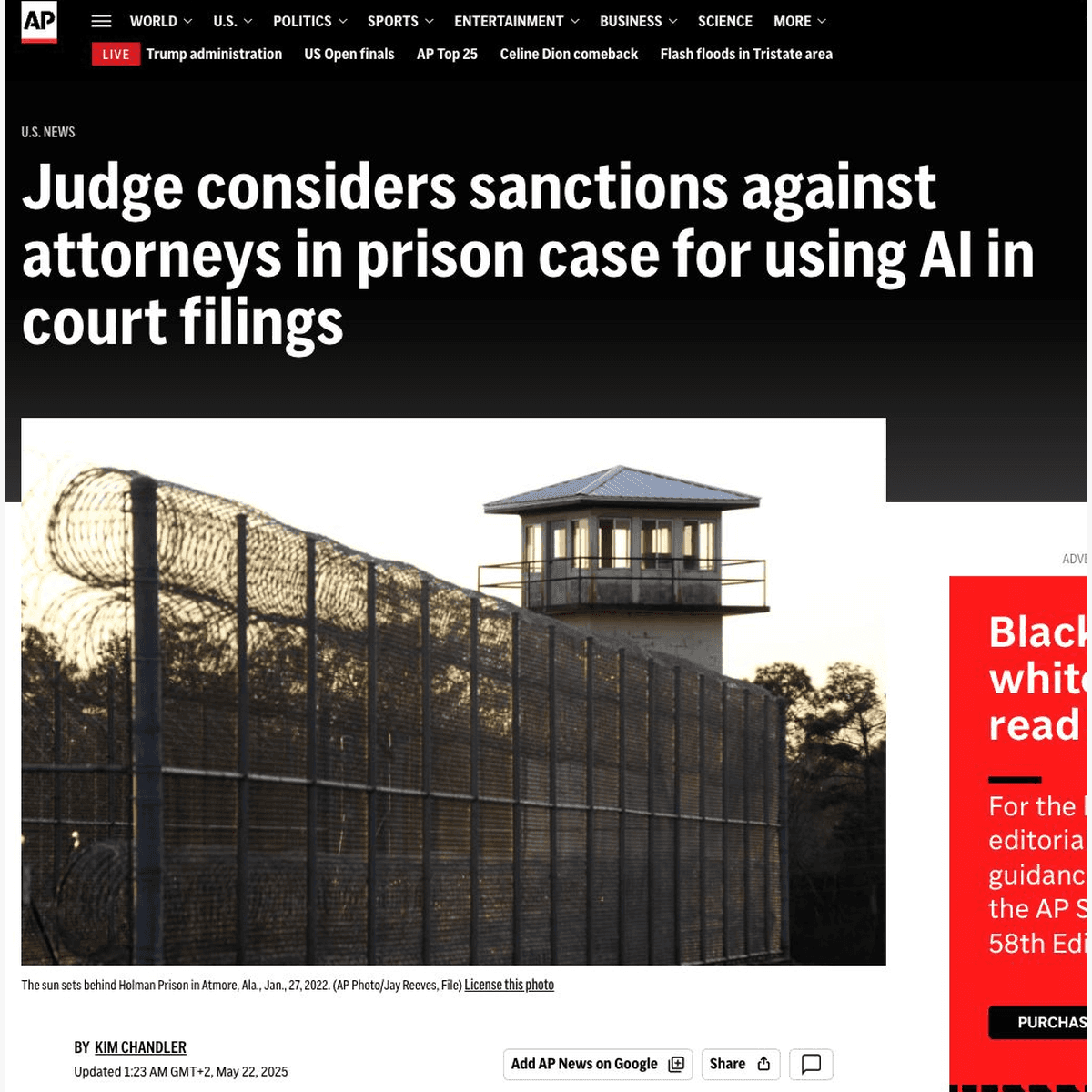
Butler Snow: Five false citations in two court filings.
Read original article ↗
The Guardian · 6 October 2025

Deloitte: Partial refund after errors in an AI-assisted report.
Read original article ↗
Bloomberg Law · 21 April 2026

Sullivan & Cromwell: Apology for AI errors in a court filing.
Read original article ↗
2,041
Cases recorded worldwide
More than isolated incidents. A publicly documented trend.
Damien Charlotin collects judicial decisions involving AI hallucinations: fabricated references, false quotations and other errors. His growing database documents specific cases and how courts responded.
General Language Models
Training knowledge instead of source inventory
Quotes without verification against the source
No labeling of unsubstantiated statements
Data processing mostly in the USA
Jurata® Legal Agent
Official Swiss legal sources, continuously updated
Semantic check: Does the original source support the statement?
Unverified statements marked and automatically improved
Storage in Switzerland, inference in Switzerland and the EU
Statement by statement
Every statement is checked semantically against its source.
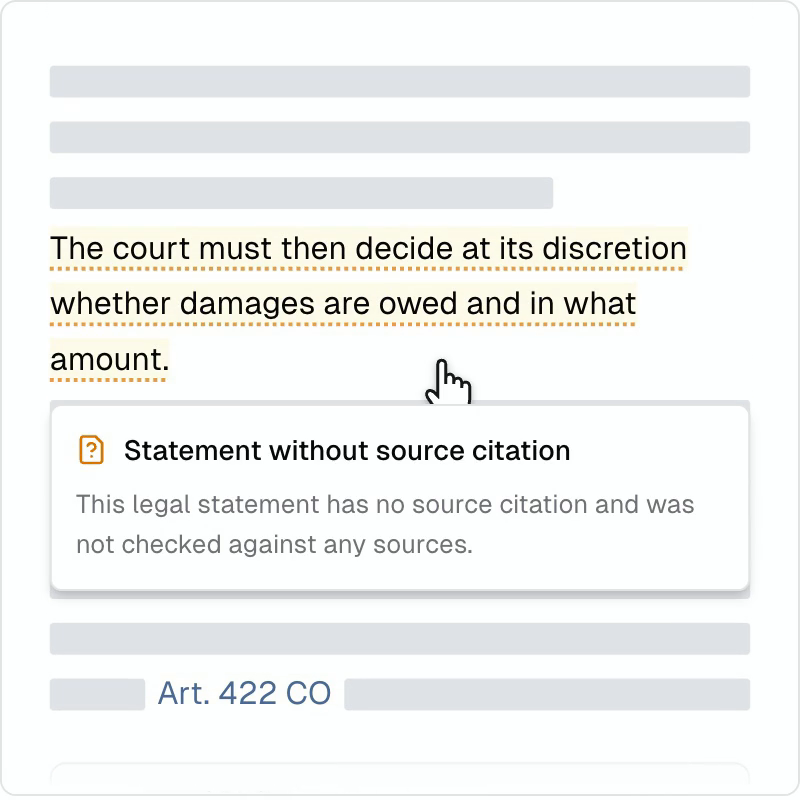
After generating an answer, the Jurata® Legal Agent checks whether the cited original sources substantiate each statement. This semantic validation shows what is fully, partially or not supported — directly below the answer.
Statements: covered by sources or only partially proven
Source references: correctly or incorrectly assigned
Affected areas are marked in the response
Art. 725b para. 4 no. 2 CO supports the existence of an express 90-day framework, but the sources provided for this statement do not support the additional claim that the older Supreme Court criteria on the seriousness of restructuring prospects remain relevant under the new law.
Supports that postponement of court notification is tied to a reasonable prospect of remedying overindebtedness within a reasonable period, with an express outer limit of 90 days after submission of the audited interim accounts.
Self-correction
The first self-critical legal AI.
When the semantic check finds an unsupported statement, it does more than flag it: the Jurata® Legal Agent attempts to improve the passage automatically and identifies the correction. You can see what changed.
Automatic improvement of unoccupied spaces
Transparent counting of corrections
Red-marked quotes if a source does not fit
Click to the source
Trust is good. Verification is better.
Each quote is linked to the original source. A click opens the article or decision in the sidebar and highlights the relevant passage in yellow. If the section is not a match, a banner warns you.
Highlight of the occupied passage
Direct link to fedlex.admin.ch and bger.ch
Warning in case of inaccurate citation
Convince yourself.
Try for free for 7 days, no credit card required. Or see it in 20 minutes in the demo.