Web app

The web app for daily legal work

Research, documents and drafts in one place. With Skills, custom instructions and four languages.

Recent
Today
Yesterday
Last week
Insured earnings for an accident insurance pension
Deep Agent
17.09.2026
Mr A has an accident on 1 January 2023 and becomes disabled. From January to June 2022 he earned CHF 40,000 working for company X. He was then unemployed for two months. From September to December 2022 he earned CHF 35,000 at company Y. What is the insured annual income for his Swiss UVG disability pension? Explain the assumptions if necessary.

I understand that you want the UVG insured annual earnings relevant for calculating an invalidity pension, based on a work history with unemployment periods before the accident. I have no indispensable follow-up questions, because I can state the necessary assumptions expressly.

Search across 5’398 federal acts and ordinances completed
Search across 202’722 Federal Supreme Court decisions completed

The first sources show the basic rule: for a UVG pension, the relevant basis is the wage earned in the year before the accident, but unemployment during that year can trigger a special rule. The decisive provisions are Art. 15 AIA, Art. 22 para. 4 AIO and Art. 24 para. 1 AIO, so I will verify the case-law context before fixing the number.

Search across 202’722 Federal Supreme Court decisions completed

The search results point to a specific line of cases on unemployment periods shortly before the accident. I will now check the decisions that are central for this scenario, because the calculation turns on how unemployment periods are filled.

Search across 202’722 Federal Supreme Court decisions completed

This full decision is directly analogous in method: for periods before a new job, the wage before unemployment is used, and from the new employment onward the actual wage at the new employer is used (BGer 8C_879/2008 consid. 3.2). I will also check the other decision that explains period-by-period allocation in an unemployment scenario.

Court decision full text retrieved

The second full decision confirms a period-by-period approach and says that the exception for unemployment is used only for the periods where unemployment caused no or reduced wage (BGer 8C_549/2007 consid. 8.3.4). I should also check the commentary on the key provisions if available.

Court decision full text retrieved

No OFK commentary is available for Art. 15 AIA. I will briefly check whether there is any current official guidance that confirms the statutory framework or cap for 2023.

Search for relevant web sources completed

Facts

Mr A had an accident on 1 January 2023 and became disabled. In the year before the accident, he earned CHF 40'000 from January to June 2022 at company X, was unemployed in July and August 2022, and earned CHF 35'000 from September to December 2022 at company Y.

I assume that these amounts are gross AHV-relevant wages, that the months stated are full months, that there were no unpaid wage components still due, no 13th salary omitted from the figures, no family allowances to add separately, and no special maximum issue. I also assume that unemployment was the reason for the wage gap in July and August 2022.

Legal Question

What is the insured annual earnings (versicherter Jahresverdienst) for calculating a Swiss UVG invalidity pension where the insured person had two jobs and a two-month unemployment gap in the year before the accident?

Legal Basis

UVG daily allowances and pensions are calculated on the basis of the insured earnings (Art. 15 para. 1 AIA). For pensions, the insured earnings are, in principle, the wage earned during the year before the accident (Art. 15 para. 2 AIA). The ordinance specifies that, for pensions, the basis is the wage earned during the year before the accident with one or more employers, including wage components not yet paid but legally owed (Art. 22 para. 4 AIO).

If the insured person earned a reduced wage in the year before the accident because of unemployment, the insured earnings are determined according to the wage the person would have earned without the unemployment (Art. 24 para. 1 AIO). The Federal Supreme Court applies this rule period by period: for the period before a new job starts, the wage before the unemployment is used, while from the start of the new job the actual wage at the new employer is taken into account (BGer 8C_879/2008 consid. 3.2). The exception for unemployment is applied only for those periods in which unemployment caused no or reduced wages, while the actually earned wage remains decisive for the other periods (BGer 8C_549/2007 consid. 8.3.4).

Application to the Case

The relevant period is the year before the accident on 1 January 2023, therefore essentially 1 January to 31 December 2022.

For January to June 2022, the actual wage at company X is counted. That gives CHF 40'000.

For July and August 2022, Mr A was unemployed. Under Art. 24 para. 1 AIO, this unemployment-related wage gap should be filled with the wage he would probably have earned without unemployment. On the assumptions above, the best proxy is the wage level at company X immediately before unemployment. Since he earned CHF 40'000 over 6 months, the monthly equivalent is CHF 6'666.67. For 2 months, this gives CHF 13'333.33.

For September to December 2022, Mr A actually earned CHF 35'000 at company Y. Under the case law, this actual wage at the new employer is used for that period rather than replacing the whole year with the earlier employer’s wage (BGer 8C_879/2008 consid. 3.2, BGer 8C_549/2007 consid. 8.3.4).

The calculation is therefore:

CHF 40'000 for January to June 2022
+ CHF 13'333.33 for July and August 2022
+ CHF 35'000 for September to December 2022
= CHF 88'333.33

Rounded to the nearest franc, the insured annual earnings are therefore CHF 88'333.

Reservations

The result depends on the assumption that the CHF 40'000 and CHF 35'000 are complete gross wages relevant under AHV rules and that no additional wage elements, such as a 13th salary, bonuses legally owed, or family allowances, must be added under Art. 22 para. 2 AIO and Art. 22 para. 4 AIO.

If evidence showed that, without unemployment, Mr A would not have continued earning at the company X level in July and August 2022, the replacement amount for those two months could differ under Art. 24 para. 1 AIO.

Conclusion

On the stated assumptions, Mr A’s insured annual earnings for the UVG invalidity pension are CHF 88'333.33, or CHF 88'333 rounded. The two unemployment months are not treated as zero-income months, but are filled with the hypothetical wage he would have earned without unemployment.

Response Validation
1 statement only partially supported

The affected statement is marked in the answer. Please review it carefully. All 13 citations are correctly attributed.

Actions
Follow-up questions
Legal Agent can make mistakes. Check all results carefully.
Version from 1.1.2026Updated 3 days ago

Art. 15 UVG

Proves that daily allowances and pensions are calculated based on the insured earnings.

Abs. 1
Taggelder und Renten werden nach dem versicherten Verdienst bemessen.

Abs. 2
Als versicherter Verdienst gilt für die Bemessung der Taggelder der letzte vor dem Unfall bezogene Lohn, für die Bemessung der Renten der innerhalb eines Jahres vor dem Unfall bezogene Lohn.

Abs. 3
Bei der Festsetzung des Höchstbetrags des versicherten Verdienstes nach Artikel 18 ATSG bezeichnet der Bundesrat die dazu gehörenden Nebenbezüge und Ersatzeinkünfte. Dabei sorgt er dafür, dass in der Regel mindestens 92 Prozent, aber nicht mehr als 96 Prozent der versicherten Arbeitnehmer zum vollen Verdienst versichert sind. Er erlässt Bestimmungen über den versicherten Verdienst in Sonderfällen, namentlich bei:

a.
langdauernder Taggeldberechtigung;

b.
Berufskrankheiten;

c.
Versicherten, die nicht oder noch nicht den berufsüblichen Lohn erhalten;

d.
Versicherten, die unregelmässig beschäftigt sind.

Version from 1.1.2026Updated 11 days ago

Art. 632 CO

Highlighting the relevant passage...
Loading source…

Sources in context

From the answer to the relevant passage.

Open a cited source alongside your research. The relevant passage is highlighted so you can check the original wording in context without leaving your workflow.

Open sources directly from the answer

Relevant passages highlighted

Read the original alongside your research

Answer formats

The answer in the right format.

A quick overview, a comparison or a structured legal opinion: choose the answer format in the composer. The Legal Agent adapts the next answer accordingly.

Six answer formats to choose from

From bullet points to legal opinions

Set the format for the next answer

Enter your message here...

Skills

Your workflow. One click away.

Save instructions for recurring tasks as skills. Select the right skill in the chat to give the Legal Agent clear guidance for the next step.

Save your own instructions

Select skills in chat or with /

Handle recurring tasks consistently

Sources

Swiss legal sources. Directly available.

Legislation, case law and commentaries form the basis of your research. In the source overview, you can see which collections the Legal Agent covers.

Federal law and cantonal legislation

Court decisions of the Federation and cantons

Comments from Orell Füssli

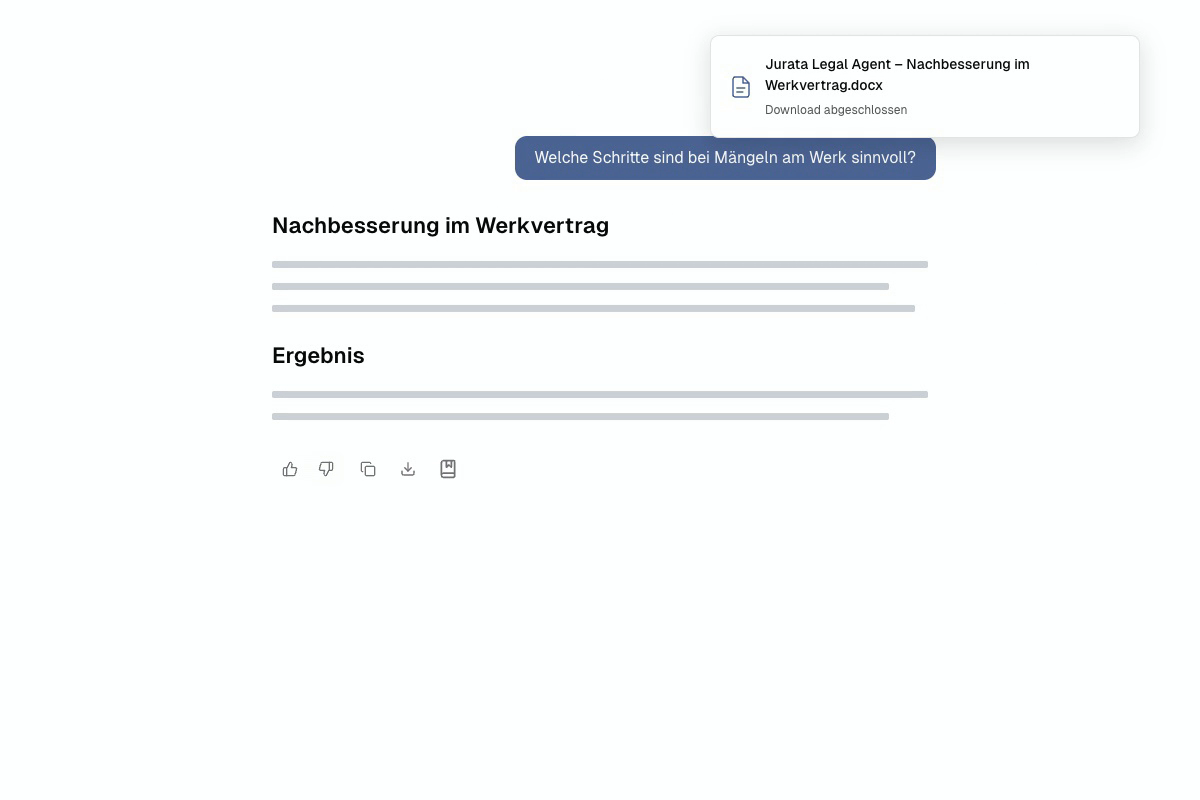
Export

Take results with you. Continue working directly.

Export your answer as a Word document or PDF. This allows you to take the results from the web app directly into your next work step.

Export answer directly from the chat

Word and PDF to choose from

Further process and share results

Convince yourself.

Try for free for 7 days, no credit card required. Or see it in 20 minutes in the demo.

Frequently asked questions about the web app

Do I need an installation?

How do my employees log in?

Is there a Dark Mode?