
Jlona, could you tell us what Legal Design is all about?
Legal Design aims to prepare legal topics in a comprehensible and appealing way for the needs of users, i.e. to design the information in terms of content, visuals, language, and in a "user-centered" manner.
What does "Access to Justice" mean to you personally and where do you see the relevance of Legal Design in legislation?
For me, Access to Justice has 3 pillars: The claim stands and falls first and foremost with the first pillar: protection and justice for all, in particular, of course, the safeguarding of human rights and the protection of minorities.
A second pillar is the enforceability of these claims: access to courts and authorities as well as professional support in enforcing their rights that is financially affordable for those seeking justice.
Much is being done regarding these two topics in Switzerland and I think we are doing fairly well – especially, of course, compared to certain other countries. New companies and business models are constantly emerging that challenge the traditional services and cost factors of professional legal support. Just think of legal advice services for under CHF 100 per hour, "step-in" legal advice shops, and the numerous platforms where you can download templates and contract templates for little money.
That's true, there's a lot going on at the moment and we at Jurata also want to set impulses in the area of cost transparency, for example – but where do you still see gaps in the system in Switzerland?
For me, Access to Justice also includes a third pillar: It starts right there, where my elderly but mentally top-fit neighbor can obtain information as independently and easily as possible about what she should provide in her will so that her last wishes can actually be met. Especially in simple family and financial cases, as is the case for her.
For me, Access to Justice also means that a company must be able to understand the basic data protection requirements and implement them even without an internal legal or compliance department or high external consulting costs.
And, of course, that contracting parties understand what they are signing, why, and with what consequences.
From my point of view, this pillar is the biggest problem today; we still have to work on that. And this is where Legal Design can contribute to a solution.
But isn't it the task of lawyers to enlighten and advise those seeking justice about the content of laws and contracts?
In complex cases, of course. If I want to build a house, I need architects, structural engineers, construction managers, electricians, etc. But if I have a bathroom, I don't want to have to call the plumbing business every time just to take a shower.
When it comes to contracts and instructions, it is, in my view, in the very best interest of companies to make access as independent, comprehensible, and appealing as possible for their addressees – especially in times when customer and employee satisfaction as well as compliance topics (supposedly) play such a big role.
And what does that mean for the design of laws?
You can have different opinions on this. Everyone must obey laws, that much is clear. But the decisive questions are probably: Should and can laws serve directly as reference works for the instruction of "citizens"? Or are they addressed exclusively to lawyers because our complicated legal system and the interaction of norms can only be understood with a legal education anyway? Or are laws in the first place even just a documentation of substantive results of our (political) legislative processes?
What is your opinion on this?
The answer is not simple – it is an interaction of all three functions with corresponding conflicting goals and compromises. But when I see our laws and all the problems with their interpretation and application, I am not sure whether such compromise solutions are suitable to meet the different requirements.
In the design of laws aimed at the general population, the needs of their addressees would, in my view, have to be given significantly higher weight than is the case today. For very specific topics that are only consulted and applied by a few specialists anyway, I could imagine a lower bar.
But isn't it clear that all laws must first and foremost be addressed to citizens who are not legally trained?
Yes, that is fundamentally true. The Federal Chancellery website explicitly states that legal regulations can only have their effect if they are understood by the people who have to apply the regulations, which is why they should be close to citizens, transparent, and comprehensible. But I have the impression that this aspiration is not, or only partially, fulfilled today.
What do you think is the reason for this?
As mentioned, I think that the different functions, conflicting goals, and the need for compromises contribute significantly.
It is also questionable whether legal norms that must apply to an indefinite group of people and a variety of different cases can fulfill an instructional function and serve as a reference work.
Another question is whether the organization and legislative processes in Switzerland even make the fulfillment of this aspiration possible or at least more difficult. In the Federal Administration, there are professional legislative editors who detect content and systematic contradictions in drafts and ensure linguistic clarity. But given the volume of legal texts, the scarce resources, and the narrow leeway resulting from the political opinion-forming process, their possibilities are probably limited.
In your view, would purely linguistic improvements be sufficient?
No, of course not. This also includes that the information sought is found, that those seeking justice can navigate the topics meaningfully, in context and from the user's perspective, and that the information is organized and presented using the most appropriate means. Legal Design, as I understand and apply it, includes information and communication design, which goes much further than just linguistic means.
During our research, we came across your very illustrative example of a rewording of the provision on profiling in the new Data Protection Act. Wouldn't such linguistic adjustments already help many people seeking justice?
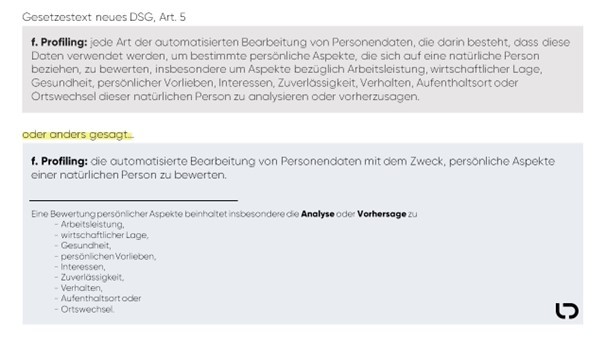
This is not primarily about linguistic changes; the wording is practically identical. This simple example shows that we have significantly more tools in our trick bag than just language. Here, for example, I separate different categories of information, formed a visual hierarchy, implemented optical filters, and used a list format. As information designers, we must learn to make information processing as easy as possible for the addressees and to make optimal use of the means available to us to achieve this.
Exciting. Leaving aside a more comprehensive system change in our legislation, which we probably – if at all – will not experience so quickly: What, in your view, could be improved in the current system?
There are various approaches.
Laws are published online and freely accessible. But search, navigation, and orientation for those seeking justice are still far from being truly user-friendly. Someone who is not legally trained has little chance of even finding the laws and regulations relevant to their questions.
To return to the example of my neighbor: In the keyword search "testament", 357 hits appear, most of them are international agreements irrelevant to her purpose – seriously, how is she supposed to find her way around there?
Or let us think of a product manager in an IT company who wants to develop, produce, and distribute her service in compliance with data protection laws: She will find the Data Protection Act, but even after conscientious study, she will only partially understand what she actually has to do.
Isn't another problem the fact that legislative concepts are often already very complicated?
Definitely. The concepts are the result of political processes, divergent interests, and corresponding compromises. It is difficult to create simple, comprehensible, and manageable concepts on this basis for their addressees.
Therefore, it is all the more important to invest in the design of complicated concepts suited to the addressees. It would be worth a try to present certain topics visually and graphically. I have not seen any requirements that would forbid such a thing. Even an layout that is a bit more user-friendly and optical guidance for readers could improve accessibility. Or, for example, ensuring the visibility of legal definitions right where they are effectively used.
And if all that were not feasible?
In addition to the official legal texts, one could provide a "decoding" with parallel preparation of the most important elements in an understandable and appealing form, just as is currently being done on Corona topics. I could imagine that over time, this could even lead to a kind of "feedback loop" towards simplifying the conceptual, structural, and linguistic design of our formal legislation.
Many good approaches – and how could we now concretely bring this third pillar of the Access to Justice claim to life in legislation? As a flag bearer of the Legal Design topic in Switzerland, how do you see your role in this?
You expect me to take on the Legal Design topic in legislation? Of course, it would be extremely exciting to make a difference in legislation too – but I fear that would be a larger lobbying task for which players with more weight than me are needed. But even in the corporate environment, which can be directly and much faster influenced, there is still a lot that can be done for better accessibility to legal topics, we are still only at the very beginning there too.
Very good – we too will persistently pursue our mission of a better and broader Access to Justice. One last question in conclusion: How did things continue with your neighbor?
I had printed out the relevant statutory provisions on inheritance law and an information sheet on the difference between being appointed an heir and a legacy for her. A few days later, she brought me a box of chocolates with a card, in which she only thanked me for the "very useful" information sheet – I think that says it all…
Yes, that makes one thoughtful. We thank you very much for the interesting conversation and wish you lots of fun and success on your path! And to all interested readers, we highly recommend the website of Legal by Design stock corporation , where more information and inspiration on the subject of Legal Design can be found.
The interview was conducted by Luca Fábián.

About Luca Fábián
Luca holds a Master of Law from the University of Zurich and has diverse experience in the legal sector, which he gained among others in renowned commercial law firms. In addition, he has conducted research at the interface between law and IT. At the beginning of the Corona crisis, Luca co-founded the non-profit legal advice service Legal Help and scaled it to over 100 volunteers. Luca combines strategic acumen and a great enthusiasm for working in a passionate team. To balance the hectic startup routine, he enjoys doing all kinds of sports. 💪🏼