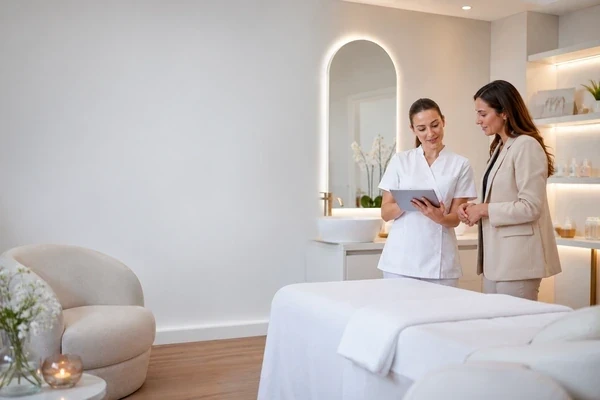
Which legal form is suitable for a beauty salon?
For many founders, a sole proprietorship is the easiest way to start. If you are starting out alone, need little capital and your risk remains manageable, this form is uncomplicated. You do not establish a separate legal entity, but act as an entrepreneur yourself. However, this also means that you are generally personally liable for business obligations.
An entry in the commercial register is not always immediately mandatory for a sole proprietorship. A natural person running a business must have their sole proprietorship registered at the place of establishment if a turnover of at least CHF 100,000 was achieved in the last financial year. Below this threshold, voluntary registration is possible (Art. 931 Abs. 1 OR, Art. 931 Abs. 3 OR).
The LLC, on the other hand, is a separate company. In principle, only the company's assets are liable for its liabilities (Art. 772 Abs. 1 OR). This can be attractive if you open a larger studio, hire staff, sign long-term lease agreements, or work with higher investments. For this, the LLC needs at least CHF 20,000 share capital (Art. 773 Abs. 1 OR). It is more formal, costs more to found, and involves more administration.
As a rule of thumb: Anyone starting a small beauty salon part-time or alone often checks the sole proprietorship first. Anyone who wants to scale professionally from the start, employ staff, or separate liability risks more strictly from personal assets checks the LLC. If you need support with the founding process, Jurata is always happy to help.
Does a beauty salon in Switzerland require a permit?
For classic cosmetic treatments, there is no single Switzerland-wide «beauty salon permit» that works the same way for every case. What matters is your location, your premises, and your specific offer. Therefore, before opening, you should clarify with the municipality and the cantonal enforcement authority whether a notification, inspection, or permit is necessary.
Particularly important is the distinction from treatments with an increased health risk. Basic professional training as a beautician EFZ includes, among other things, caring, skin-improving, aesthetic, and decorative treatments on the body and face. This also includes anamnesis, skin assessment, advice, hygiene, occupational safety, and health protection.
However, this does not mean that every treatment can automatically be offered freely. As soon as devices with non-ionizing radiation or sound are used, such as lasers, IPL, ultrasound, or certain radio frequency applications, additional rules apply. Depending on the type, such treatments may only be performed by doctors, by practice staff under medical supervision, or by individuals with a certificate of competence (Art. 5 Abs. 1 V-NISSG). Certain treatments are even reserved exclusively for doctors or their practice staff (Art. 5 Abs. 2 V-NISSG).
For a classic salon, this means: If you stick to non-invasive standard treatments without lasers, IPL, ultrasound, or medical interventions, the entry barrier is usually lower. As soon as you want to offer apparative or medically active treatments, you need a separate assessment of the requirements.
Which insurances are really important?
If you want to found a beauty salon in Switzerland, you should not wait until after the opening to check insurances. Even an allergic reaction, a fall in the salon, or damage to rented premises can be expensive.
Operating liability insurance is practically central for beauty salons. It typically covers personal injury and property damage that can arise in connection with the operations. Precisely because you work directly on the bodies of customers, you should check carefully whether cosmetic treatments, products used, mobile services, and any employees are co-insured.
Particularly mandatory are social insurances. Anyone who lives in Switzerland or is gainfully employed here is AHV-insured (Art. 1a Abs. 1 AHVG). Gainfully employed insured persons are liable to pay contributions as long as they are gainfully employed (Art. 3 Abs. 1 AHVG). Income from self-employment includes, among other things, income from commercial enterprises and other self-employed activities (Art. 17 AHVV). As a self-employed person, you must therefore register with the compensation office and correctly settle your AHV contributions.
For occupational pension plans, the situation is different. Self-employed persons can voluntarily join a pension institution (Art. 44 Abs. 1 BVG). If you employ staff, however, additional obligations apply. Employees with an annual salary above the legal threshold are subject to the mandatory occupational pension scheme (Art. 2 Abs. 1 BVG). Employers who employ staff subject to mandatory insurance must join a registered pension institution (Art. 11 Abs. 1 BVG).
Accident insurance also becomes important as soon as you employ staff. Employees employed in Switzerland are compulsorily insured according to UVG (Art. 1a Abs. 1 lit. a UVG). Self-employed persons can insure themselves voluntarily according to UVG (Art. 4 Abs. 1 UVG). In addition, daily sickness allowance insurance, legal protection insurance, property insurance for furnishings and stock, and cyber insurance can be useful.
What applies to cosmetic products in the salon?
Many founders underestimate the product side. If you only use cosmetic products in the salon, you must use safe and correctly labeled products. If you sell, import, fill products yourself, or offer them under your own brand, the requirements increase.
Manufacturers and importers must ensure that cosmetic products comply with the food law requirements (Art. 3 Abs. 1 VKos). Distributors also have obligations, especially if they place products on the market for the first time under their own name or brand, or modify a product already placed on the market in such a way that its conformity may be affected (Art. 3 Abs. 3 VKos).
Labeling is also regulated. Packaging and containers must carry, among other things, the purpose of use, the responsible person, the minimum shelf life, the batch number, as well as warnings or special safety measures, in so far as this information is necessary (Art. 9 Abs. 1 VKos). Therefore, anyone who wants to sell their own creams, serums, or oils should not do so spontaneously out of the treatment room, but should first check the product and labeling obligations.
When do you become liable for VAT?
Cosmetic services and product sales can become relevant for value added tax. In principle, anyone who runs a business and provides services in Switzerland or has their registered office, domicile, or permanent establishment in Switzerland is liable for tax (Art. 10 Abs. 1 MWSTG). However, anyone who generates less than CHF 100,000 in turnover from taxable services in Switzerland and abroad within one year is exempt from tax liability (Art. 10 Abs. 2 lit. a MWSTG).
For your beauty salon, this means: Plan for VAT early on, even if you remain below the threshold at the beginning. As soon as your turnover grows, you must check whether registration is required. Especially with mixed offers of treatments, product sales, and vouchers, clean bookkeeping pays off from the start.
How do you proceed practically with the founding?
Start with a clear offer. Determine whether you exclusively offer classic cosmetics or whether lasers, IPL, ultrasound, permanent make-up, or medical-oriented services should be added later. This distinction determines which proofs and clarifications become necessary.
Then you choose the legal form. For a small start, the sole proprietorship is often pragmatic. For a larger salon with higher risk, the LLC can be useful. Then you clarify location issues with the municipality, landlord, and canton. Local rules can play a role, especially with home salons, shops, advertising signs, or structural adjustments.
In parallel, you should prepare your insurances, AHV registration, bookkeeping, data protection for customer data, and product documentation. Customer files, consents, hygiene procedures, and clear treatment information are not only professional but also help to avoid disputes.
Frequently asked questions about beauty salons in Switzerland
Do I need training to open a beauty salon?
For classic cosmetics, there is not in every case a uniform federal training obligation for opening a salon. Nevertheless, sound training is very important because beauticians work close to the body and must master hygiene, skin assessment, product knowledge, and occupational safety.
Am I allowed to offer laser or IPL in the beauty salon?
Yes, but not simply without further examination. For certain cosmetic treatments with non-ionizing radiation or sound, a certificate of competence or medical responsibility is required (Art. 5 Abs. 1 V-NISSG). Some treatments are reserved for doctors or their practice staff (Art. 5 Abs. 2 V-NISSG).
Do I have to register my beauty salon in the commercial register?
As a sole proprietorship, you must register if you achieved at least CHF 100,000 in turnover in the last financial year (Art. 931 Abs. 1 OR). Voluntary registration is also possible before then (Art. 931 Abs. 3 OR). An LLC, on the other hand, is only created upon entry in the commercial register.
Which insurance is most important?
Practically, operating liability insurance is usually the most important voluntary insurance, because it can cover typical personal injury and property damage in salon operations. Social security contributions (AHV), accident insurance for employees, and occupational pension schemes are also particularly important by law as soon as you employ staff (Art. 3 Abs. 1 AHVG, Art. 1a Abs. 1 lit. a UVG, Art. 2 Abs. 1 BVG).